



YGG Play is live at GDC!
Yesterday, WolvesDAO and OpenSea hosted a GIGACHADBAT and WaifuSweeper tournament.
5 games. One winner.
(Do yourself a favor and go to the stream to 1:48:37)
Sponsored by YGG Play


TLDR :
Cash App launched a P2E game?
Amigo: “the next Friend Tech”
Pudgy Penguins’ Pudgy World launches

🗞️ NEWS

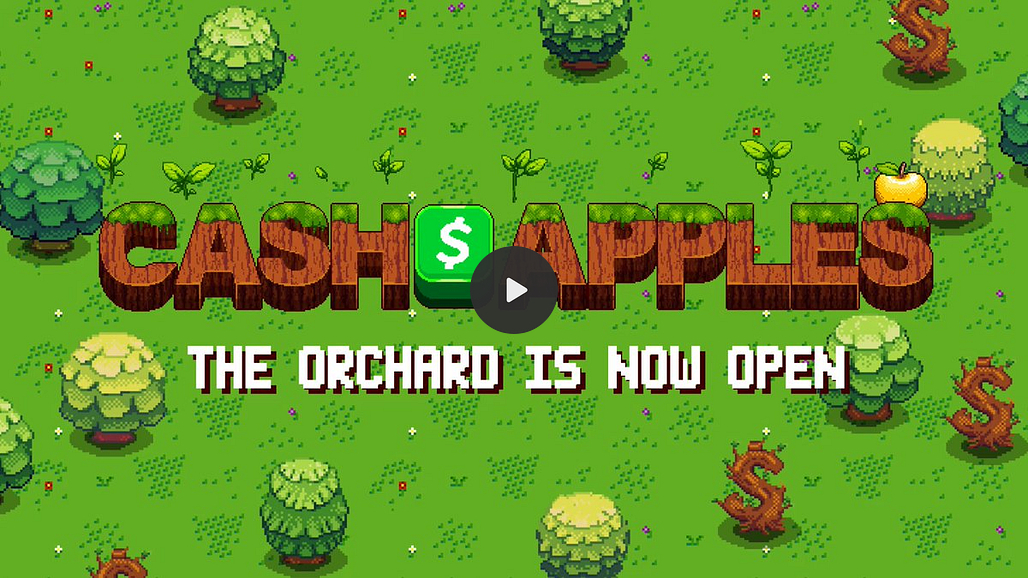
CASH APP LAUNCHED A “P2E GAME”?
A couple of days ago, Cash App surprised us with the announcement of a game called Cash Apples (CA). The game is extremely basic, the graphics are pixelated, and players could earn real cash by playing, making it awfully reminiscent of crypto gaming in 2021 - 2022. So, you’d probably wonder: “Why Cash Apples?” Here’s my attempt to make sense of it…
For context, Cash App is one of the largest digital (non-crypto) wallets in the US. It’s mainly used for sending and receiving cash (fiat), and users can also buy Bitcoin and invest in stocks on the app
As of Q1 2025, Cash App had 57M MAUs, making it larger than Robinhood with 27M (funded) customers as of January 2025
So what is CA? “Cash Apples is a web game where you walk through a virtual orchard, shake trees to find Golden Apples, and earn real cash sent straight to your $Cashtag”.
After shaking a tree, the rarest drop would be a Golden Apple, but most often, you would find random collectibles (without cash value). The more Apples you collect, the higher reward tier you hit:
Apple to $ ratio: 1:$1 - 5:$2 - 15:$5 - 30:$40 - 75:$100
The game was scheduled to run for only 5 days. Every day, it was open for a limited amount of time (only 4 hours). Plus, the cash pool was limited, so it could run out before the time lapsed
When giving out $ directly, it seems like the companies start acting sensibly and understand that earning has to be limited. Unlike the early crypto games, in which this sensibility didn’t apply to their native game tokens
When playing, players could see the prize pool for every day, plus how much cash was already collected on the day they were playing. The prize pools were pretty significant as well: D1: $80K, D2: $85K, D3: $90K, D4: $95K, andf D5: $150K (total: $500K)
However, because the turnout was so significant (more on this later), the pools got diluted, and most people earned peanuts. People shared that they only earned $1 or $2 after an hour, while some shook 1000s of trees without finding a single Golden Apple
Rewards were sent to players a day after, directly to their cashtag (usertag). Users were free to use this cash as they pleased
As said, it’s a pixel game. Ben jokingly said it looked like a mix of Cambria and Pixels
CA was supposed to run till the 13th of March. However, the game had already shut down after its second day, due to 350K players trying to get in:
“What was designed as a lighthearted online orchard quickly drew a crowd large enough to overwhelm the experience, leaving hundreds of thousands of hopeful harvesters refreshing the page from outside the gates.”
Funnily enough, they spun up a new website called “The Appleton Post” to bring the announcement, including that it’s uncertain whether CA will return
So, why would Cash App launch CA and give out $500K?
It’s making use of the “house money effect”. It’s a behavioral bias where people see gains (cash rewards in this case) differently from their own money. In a sense, it feels like “free money”, meaning they’re more likely to take a risk with it and buy stock and Bitcoin with it (on Cash App)
This can lower the barrier to users making their first investment. A bridge to start interacting with more of Cash App’s investment products (likely where they make more margin than on transactions)
This is probably a bit far-fetched, but it could have been an attempt to increase mindshare among the crypto crowd, because you can also buy Bitcoin on the platform
If every user got $1-$5, that would be a cheap acquisition channel (for a fintech company) to attract new users, plus a way to (re-) engage existing users
The campaign also reminds me of this time when some DeFi apps launched a Telegram game in 2024 - 2025
It associates Cash App with money gains, creating positive reinforcement around the brand
However, whether this activation achieved that is something I’d question, considering the many bugs and server issues
Lastly, this experiment from Cash App reinforces my thesis that the audience that is interested in “rewarded play” is much larger than just crypto. The opportunity for crypto gaming to expand in financial entertainment is huge imo
AMIGO: “THE NEXT FRIEND.TECH”?
After 7 months since its first announcement, the “new” SocialFi app, Amigo, has launched on Abstract. Luca Netz QRT’d the announcement and said: “Amigo is what Friend Tech could’ve been”
I vaguely remember criticisms of Amigo at the time, after its first announcement (now deleted) of being a Friend.Tech (FT) copy. So, let’s compare the two
To start with this comparison, we’ll take a look first at why FT failed, and then move on to how Amigo compares. So, why did FT fail? Grok says:
FT failed to deliver beyond meaningful features to retain users beyond speculation
The revenue model and economic design were flawed. Most revenue came from a 10% fee on key trades, a 50/50 split between the platform and creators, but this zero-sum structure led to extraction over value creation
There was a huge database leak in August 2023, which led to a huge loss of trust and user churn
In May 2024, FT returned with V2.0 and the FRIEND token airdrop. However, the app was still clunky, new features such as social clubs underdelivered, and the token price crashed post-airdrop
FT’s team was anonymous, plus had a questionable past. The platform generated $44M in revenue, but little was done to improve the product itself
How does Amigo compare?
Amigo’s main mechanic is about buying keys from your favorite creators, which can increase in value as they become more popular. It’s about speculation. The social feature it offers is a gated chat room, which is the same as FT, where “fans” can talk to creators
Instead of being solely based on the bonding curve, keys in Amigo are also priced based on a creator’s social metrics
With FT, people stopped caring about the chatroom feature rather quickly, because speculation was a much stronger motivation
It looks like Amigo uses the same monetization model as FT, revolving around trading fees. On every trade, they charge 8%, of which 3.5% goes to Amigo, 3% goes to creators, and 1.5% goes to a referral pool (potluck)
Again, this system leads to capital depletion (fees shrink the pie) unless new buyers constantly enter. This fee structure could work if there is new value being created, but it seems too similar to FT’s design, centered around speculation only
There’s also a 0.25% referral fee on all trades, which can incentivize growth. But it won’t solve the inherent issues with Amigo’s design
What’s particular here is that Amigo takes a larger cut than the creators. With these platforms, new creators are your main growth lever to pull in new audiences (→ buyers → capital). So, the question is whether the incentive is big enough
Update: They announced they’re lowering the platform fees by 50%, while keeping the creator fees the same. Good stuff
What Amigo does improve on is the UI and UX. Try ES5HVP, LQI6WC, or 753ER4 to check it out. Signing up is simple and happens through ABS Wallet, and the layout is minimal and intuitive
In terms of onboarding new creators, Amigo is taking a curated approach. There are about 20 creators on there now, including a mix of OF models, crypto KOLs, and Abstract employees
More recently, they onboarded a “gaming streamer”, NataaGataa, with 400K followers on Twitter and 3M+ followers on Instagram. She sold a total of 38 keys so far, and earned 0.02 ETH in fees
The most-traded key (as of yesterday) on the platform is Luca’s. His key sold 219 times, and he made 1.79 ETH in fees
Part of their strategy seems to be attracting creators beyond the CT bubble. Creators will be able to connect their Instagram and TikTok accounts soon. The app is easy to use, and the branding is consumer-friendly
However, whether it can scale with normies is something I question (other than it becoming a glorified OF)
Overall, this is just Friend.tech with a better wrapper, and perhaps a slightly improved fee structure. But again, it doesn’t innovate on SocialFi in a meaningful way to make the product move beyond speculation


PUDGY WORLD LAUNCH
This week, Pudgy World (PW) went live, a social virtual world in a browser, based on the Pudgy Penguins IP. Let’s break down what we know about the “modern Club Penguin”
In September 2023, we saw the first clip of PW. The fragment shows an early version of the game, with movable Pudgy characters and a largely empty world, which just had an obstacle course. So, the game is likely in dev for ~3 years now
The game has been built in partnership with Abeto. This studio has done some impressive browser work with “The Messenger”. It looks and feels quite similar to PW
Looking at the timelines of these games, I believe they built The Messenger on top of the custom engine they made for PW. And not the other way around, like some claim….
Chef, the co-founder and CCO of Pudgy and Igloo Inc., provided some insight on how PW was built: “We built PudgyWorld from scratch. No traditional game engine. No downloads. Just open your browser and you're in.”
Furthermore, he goes into some technical stuff like how they build their physics, camera system, assets, etc.
So, what’s the game about? The first time you play, you can customize your own penguin. After that, you enter the world, which starts with a quest line about finding the missing Polly. Along the way, you’ll speak to NPCs, fish, visit different towns, and play mini-games
There are social features such as a friend chat and proximity (voice) chat
PW is free to play and monetizes through two currencies: Pebbels and Seashells. Both can be earned in-game, but shells are more premium. Currencies can be bought with a credit card only, no PENGU (and I doubt they will add PENGU as a payment option)
Using these currencies, special eggs, fishing gear, and traits (cosmetics) can be purchased. Monetization is light and largely centered around cosmetics
For context, Club Penguin primarily monetized through a subscription-based model to access exclusive features
In the main menu of PW, there’s a button that says “toy claim”. This will allow players to claim items from their physical toys in the game
PW is an extension of the Pudgy experience. Most people will find out about Pudgy through the gifs and short-form video content. After a while, they might recognize the Penguins in a Walmart
The collectibles have QR codes that lead to this online experience with unique offers (redeemables), hooking people in. It’s a “phygital experience”. Luca Netz calls it: “A massive bridge between web2 & web3”
So, why did Pudgy build this game? I think it’s simply about IP proliferation. Games can create connections (fandom) to characters that other forms of media simply can’t achieve. It deepens the brand experience
And I don’t think the game is too far off from becoming an enjoyable virtual social hangout for the younger generations, just like Club Penguin was, and Roblox now is
FLASH NEWS
BPMG is becoming the joint owner of the crypto game Cooking Adventure
Pixels started revealing what their new ad tech layer, Stacked, is looking like
DungeonCross, a new ARPG, went live on the Cross Protocol this week

🆕ALPHA CORNER
Early Games: None
Join our Telegram for daily updates & alpha as well: https://t.me/raidenalpha