

As part of my mission to find out what it takes to build and grow great consumer apps in crypto. I present to you the third edition of builder insights. An article filled with insights ranging from marketing, community, player acquisition, game design, economies, and much more.
This piece will summarize the highlights of these conversations. For more insights, you can visit the article below.

#21: Payton - Kizuna (formerly)
→ Topics: community building and community management

Quotes:
“Community…is the interaction between people, and that is also your responsibility as a community leader. Not for them to cling to you as the driving force, but also to push into relationships…”
“There are a lot of benefits of community that aren’t solely monetary: just drive KPIs down […] There are a lot of things within community that you can have, like marketing, ambassadorships, hiring pools, product-feedback loops…types of things that don’t really have a good connection to money or costs.”
“This is where people have a hard time with Discord, because they just think of Discord or Telegram as a chat message platform, when in my opinion, it’s more like Gen Z email.”
Takeaways:
The strength of a community lies in the density of member-to-member connections. Not in the leader-to-member connections. For this reason, you want to create an environment where members form relationships with each other.
If you treat the community like a KPI, you will miss how it multiplies everything else.
Using the Gen Z email framing helps you understand how to approach it: Discord = inbox, Channels = folders, Notifications = emails, Reacting to pings = open rate.
You can find more insights in the article below:
#22: Jihoz - Ronin Network
→ Topics: game and economy design, and tokens
Quotes:
“What prevents them (players) from quitting when they lose their ship? […] He (Hilmar Petursson) said that the guild mechanic and the social mechanics are really important for that. First of all, players feel like they’re contributing to something…the guilds also have systems of insurance, which will help you replace your stuff in the case of loss”
“When you do the economic balancing, don’t say that you’re doing that. Always interweave that with lore, so don’t say: the rewards are dropping, say that winter is coming. He really stressed this idea of emotion. He said that every sink in EVE Online is very closely tied to greed, wrath, anger, or love”
“Once you’ve graduated from that point (initial community distribution), you have to be really careful in how you’re emitting supply. You want to continue to incentivize people, but if you can make sure that these tokens are going to long-term aligned users via reputation. If you can make sure that they’re actually using the tokens for the things that you want them to do…you start fixing and addressing a lot of the issues of gaming tokens”
Takeaways
Tie the lore to economic balancing (emissions, sinks, burns, etc.), and in some cases, eventize them. Make it an experience that the players can join, rally around, so you also control the narrative of what changes.
What Jihoz means with the last quote is that you want to start with a relatively “broad” distribution of tokens, and follow up with a more curated (aligned) approach. I do still think that the initial distribution (1st airdrop) is often largely overlooked in terms of importance.
#23: Luke - Stacked/Pixels
→ Topics: UA and growth
Quotes:
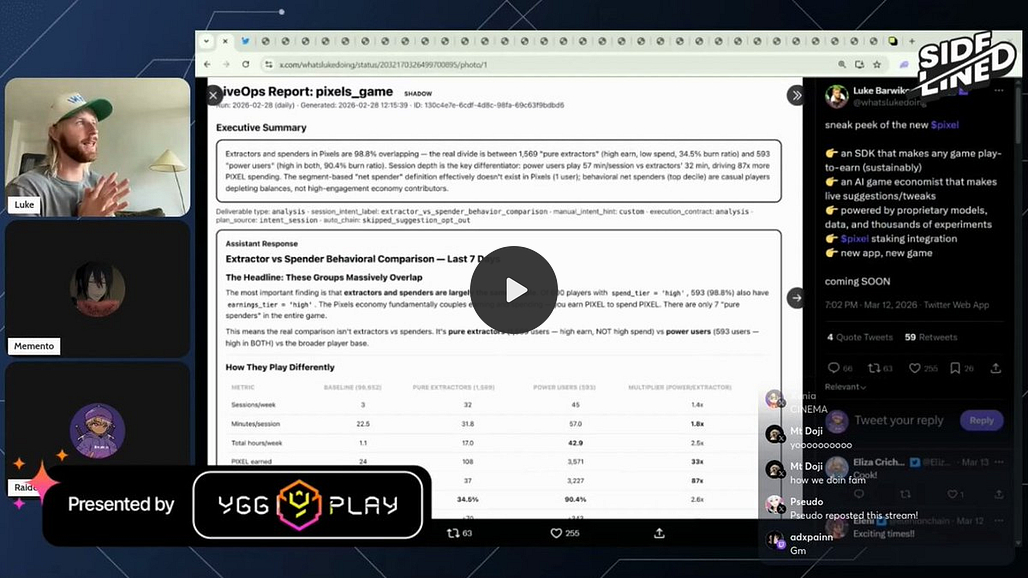
“Part of the problem (in response to extractors and spenders in Pixels being 98.8% overlapping) is the UA problem. A lot of crypto has not reached an audience of gamers, who are important, in addition to the people playing crypto games right now.”
“As a founder, it’s really easy to think that other people are wrong: ‘These people are wrong, there’s this thing that they should like’. That’s just not how the world works. You do have to build around consumer expectations. If you offer them something that surprises them, that’s genuinely better, that’s great, but if you try to force it down their throats, they’re just going to avoid the product in the beginning stages”
“Are they going to move the needle for the user experience and for Stacked as a company? The reality is: I’m not so optimistic about Web3 games right now. So, what do we really need for Stacked to work? One, we need our first-party titles to work well, or we need Web2 games that have the economics to fit this into”
Takeaways:
For your game economy to function, you need to attract an audience that is less EV-sensitive, and essentially “pays for fun.” Unfortunately, the data shows that there’s only a handful of players in crypto that play because of intrinsic motivations.
If there’s a feeling that the user has to be educated a lot to understand the value proposition of the product. You’re likely building against consumer expectations instead of around them.
The last quote was a response to how Luke is thinking about growth for Stacked, as the infrastructure can only be as good as the games being built on it. If Stacked can attract Web2 games and execute, this might spark an interesting wave of crypto gaming adoption through rewarded play.
You can find more insights in the article below:
#24: Abhi - AP Collective
→ Topics: marketing and distribution
Quotes:
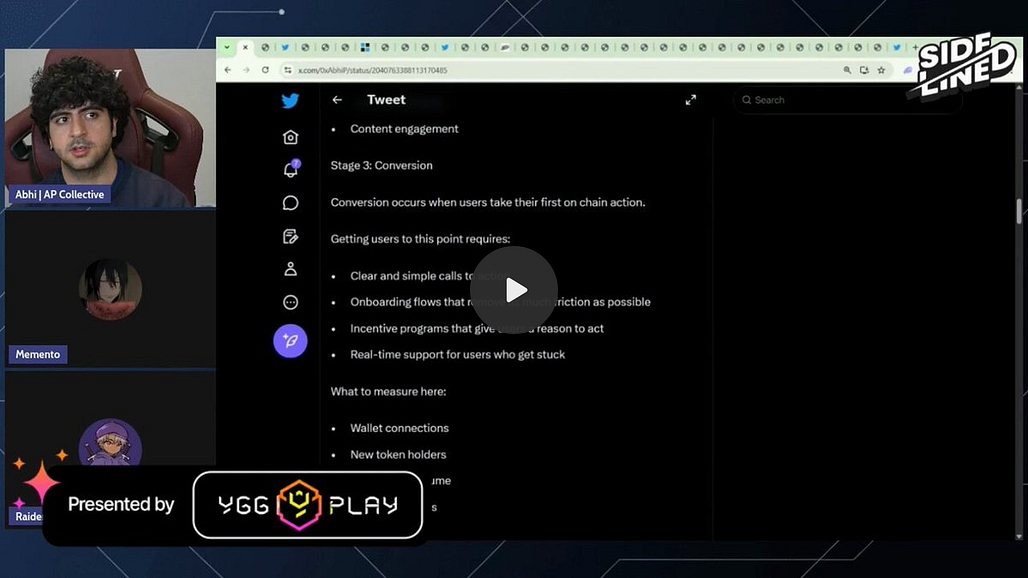
“If I post something on Twitter tomorrow, no one will remember it in a week. If I post a press release, maybe it won’t convert on D1, but people will still be able to see that when they search my project a year from now. So, in terms of producing content on Twitter that doesn’t convert, and the short-term lifecycle around dropping a hype-trailer, to me, that’s all sort of dead…”
“The biggest thing about AI or tech at the moment: development, ideation, and production have been completely abstracted in terms of difficulty, costs, etc. But distribution, users, and revenue are really difficult to achieve, which is why I’ve been using words like ROAS, because that’s what AI/tech teams are looking at”
“Spend it (in response to spending your marketing budget) on distribution and A/B test any channels they can to deliver ROAS. Spend a little bit on clipping, on X, on video production, on the distribution of certain narratives, and see what works and what’s sticking. Whenever you see a positive ROI, just re-allocate all of your resources to that specific channel until you stop seeing a positive return, and then expand to the other channels…”
Takeaways:
You can’t rely on Twitter for evergreen content. Build a library of mid-funnel resources (blogs, YT videos, press releases, etc.) to create long-term discoverability and, equally important, trust.
Marketing in crypto has been largely about guerrilla tactics and community building in the past few years. Not so much about traditional marketing. That’s likely going to change, as relying on CT for users isn’t viable anymore, and crypto companies have to explore channels beyond Twitter.
Marketing in crypto has been largely about guerrilla tactics and community building in the past few years. Not so much about traditional marketing. That’s likely going to change, as relying on CT for users isn’t viable anymore, and crypto companies have to explore channels beyond Twitter.
#25: Lethe - Kamigotchi
→ Topics: onchain gaming, founder marketing, and playtests
Quotes:
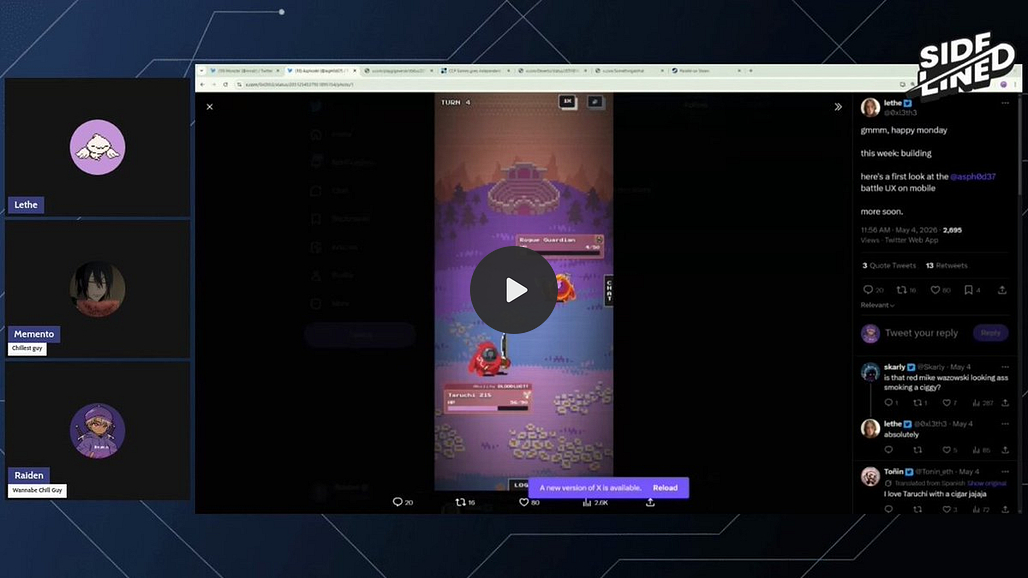
“We were really inspired by what Skarly from OCH did with Maze of Gains (MoG), because it was just so clear that adding something like this to their ecosystem brought in new users. And I think everybody in onchain gaming right now is thinking: “How do we get more distribution?”
“If you look at how marketing works for this kind of brand in Web3...The only thing that really lands is very founder-led, influencer-style mascot marketing.”
“Playtests are really important for marketing, which is why we’ll be doing a big one for Asphodel, and then just engaging people with WoM...I think playtesting is the big trick people miss. If you make a public event out of it, use incentives correctly, you can really get disproportionate amounts of leverage on users from that.”
Takeaways:
What a handful of the “onchain” games realized is that midcore/hardcore games are limited in onboarding new users. That’s why we’re seeing an uptick in more casual game loops (quick sessions, little onboarding, high dopamine) being built on top of this ecosystem to broaden the TAM. Top-of-funnel experiences that can also trickle down to the bottom of the funnel.
In the video (at 3:04), Lethe answers the “why” behind the founder-funnel. To my interpretation, it comes down to improving: marketing effectiveness, trust, relatability, community building, narrative control, and emotional buy-in.
Most teams think of playtests only as a means to evaluate the functioning of a game. Few see it as a marketing and player acquisition channel. Turn a boring playtest into something exciting by “eventizing” the process. A way to look at it is by treating it like how indie games approach their early access launch on Steam (GameDiscoverCo has a lot of good content on this topic).
You can find more insights in the article below:
#26: Caleb - SDF
→ Topics: marketing, distribution, growth, and product

Quotes:
“How do you lure them in with stuff that’s familiar to them? So, Picks, is super familiar to the FPL audience...it’s a really nice format that’s shareable, but also you can rank people nicely.”
“If you look at any sports brand, whether there’s cash or not. They are all going down the route of owning their own media. Polymarket and Kalshi are doing the same. DraftKings does the same thing with Barstool.”
“If you look at what people do with social cards for normal markets or crypto markets, you’d probably apply a lot of that to our platform. But in a much more engaging way, because it can cause discussion with huge fan bases.”
Takeaways:
Familiarity is your first step through the door. For the user, it reduces the cognitive load, anxiety, and the time to understand an app’s value. I.e., presenting a familiar concept makes adoption much easier. Once they are in, you can sell them on unique features (e.g., markets).
In the industries where customer attention and acquisition are expensive (like fantasy football and PMs), owning distribution is much more valuable than renting or partnering for long-term value capture. The companies that succeed temporarily use rented/partnered distribution to funnel it back to their owned distribution.
Crypto has a lot of social cards (e.g., Abstract XP) because they’re social currency, making them very effective for WoM marketing and driving new referrals. Most social cards are simply PnL or number cards, so think about how you can give them a unique twist that’s in line with your product. Ideally, that twist adds to the virality and wow-factor of what’s being shared.
You can find more insights in the article below:
#27: Ben - Cambria
→ Topics: risk2earn and growth
Quotes:
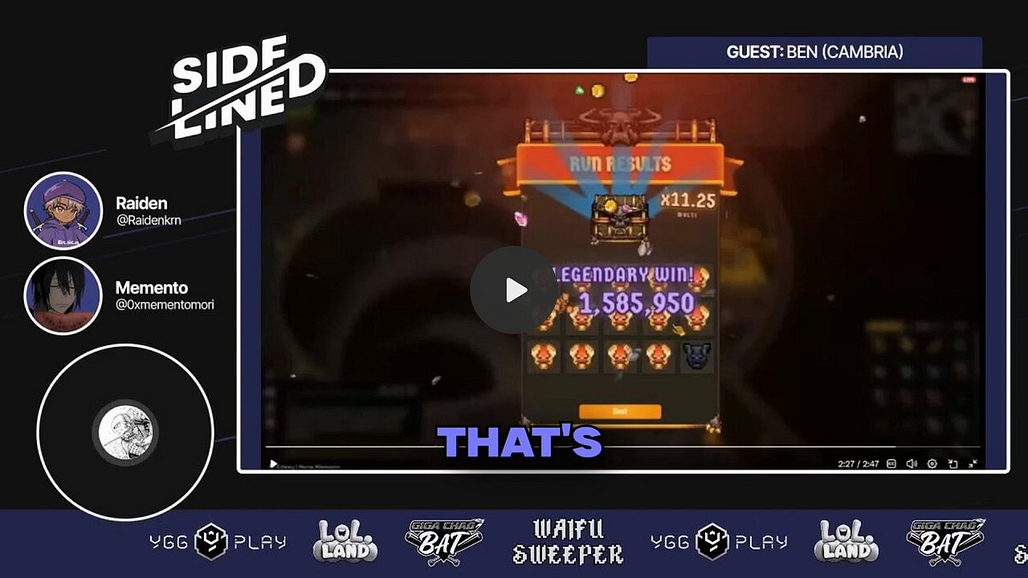
“There needs to be a twist. Like, this is the only game on the internet where I can do XYZ. So, the combination of Diablo-style gameplay, roguelikes, and the crypto stakes at the intersection of all three...there’s probably nothing out there right now that you can do remotely close.”
“Because of the dynamics of the pool, most people end up not making money. That’s just how most of these products work. If they’re not making money...money is very important to people, right? So, how can you bring them back? I think that’s the definition of successful products in this niche.”
“With financialized entertainment, there’s a floor. Obviously, with perps, memes, and prediction markets, they go vertical, still, regardless of macro. If they enjoy the product, there’s definitely a form of users that will go up, and risk-on behavior is trending. But there’s always a base of audience there. With crypto gaming specifically, the big bet is: you can convert a new audience of people.”
Takeaways:
Competing with indie games in this genre (the best comparison imo) is close to impossible, because they are objectively better games. For this reason, you need a “twist,“ a unique angle or selling point, like “real risk.” Something only possible through integrating crypto. This is also why marketing these games to an audience outside crypto should be closer to how fomo does it (the rags-to-riches fantasy) than traditional indie game marketing. The question is, how do you reach the users who have similar risk-on behaviors but would enjoy these loops in a game, instead of through memecoins?
One of the biggest challenges of risk2earn games is solving player churn after incurring losses. Especially when it comes to an audience outside of crypto, which is less familiar with these concepts in an experience close to a traditional game. The answers lie in game design and how supporting features, mechanics, and loops can reduce churn. Unironically, the best space to learn how to optimize for that is the casino, as these have mastered how to make losing players return/keep playing.
On the last point, it leads back to the conversation about memes. Games like Dungeons are engagement loops of risk, just like to perps, memes, and pms. Gaming is simply the most fun wrapper to capture these loops and has the most potential to scale (in theory). However, the playbook to make this happen currently remains largely unwritten.
You can find more insights in the article below:
#28: Heimdall - The Citadel
→ Topics: economy design
Quotes:
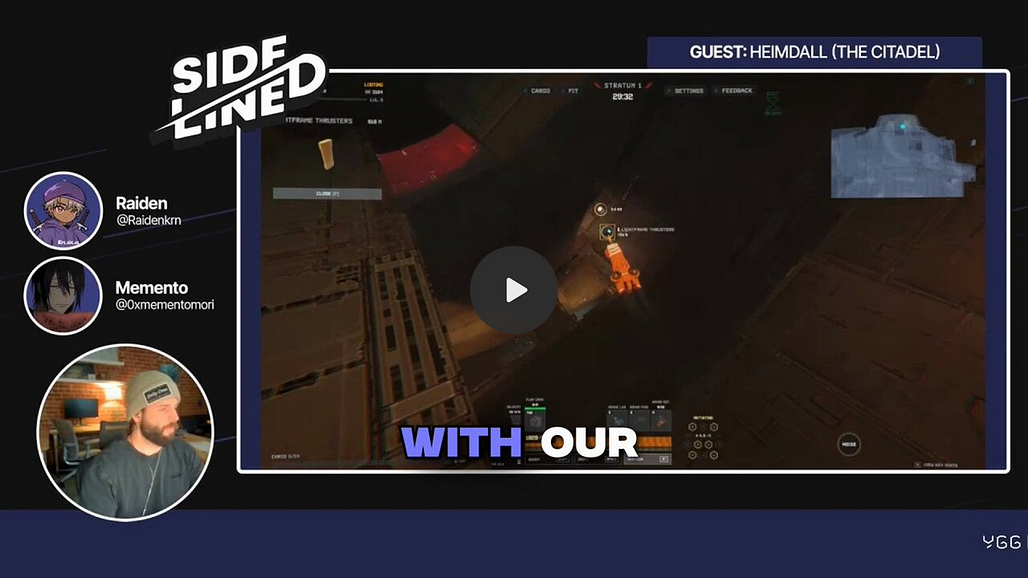
“Diablo 2 is not a fun endgame. It’s just getting the loot and progressing your character. Somehow, just getting the loot has been worth 30 years of gameplay. So, there’s something there that people should look at more.”
“Every asset emission in the game is competitive, so even in these sessions [...] For the faucet, it’s also competitive because when you’re recycling assets, you’re competing against other players for that emission. Even on the governance auctions, it’s a competitive auction in the in-game currency. I think that’s really the only way that you can make a sustainable economy.”
“A treasury-stabilized economy, where players own governance assets, and those have their value tied to the treasury. And then we stabilize the rest of the ecosystem based on those governance assets by allowing any items or currency to be converted into governance every week, when we release new emissions. It should create a really stable value for all ecosystem assets in the game, and we grow the treasury by actually driving a lot of the revenue to the player-owned treasury.”
Takeaways:
The appeal of Diablo’s “getting loot” endgame comes from the chase for better items feeling meaningful and the fact that the depth of different builds is endless. Diablo has made itemization addictive. The challenge to resolve for crypto games (beyond making something as good as Diablo) is then how “ownership” can enhance this layer, rather than take away the fun, as Diablo III’s Auction House did.
Economic sustainability is “only” possible when the emissions are competitive. It caps the total supply of new assets by player participation and skill, creates more constant demand and built-in sinks, and unifies the gameplay and economic loop.
Citadel’s economy functions based on a player-owned treasury that stabilizes the economy from the center outward. The governance assets it will issue act as the anchor, and because they’re owned by the players, that aligns the incentives. So, the more revenue the game generates, the more value the owners of the treasury (or “central bank”) generate. In theory, this creates sustainable growth.
You can find more insights in the article below:
#29: Gaspode - SDF
→ Topics: airdrops, product and economy design
Quotes:
“...so much of the data that went into the idea of the FUN score, which was your equivalent of being able to see how you were performing against other people for the upcoming airdrop, was based on how you interacted with the product. And none of the metrics were really inorganic...”
“Nearly everything in there...were organic behaviors that happened in FDF. That’s why it (the airdrop) ended up going clearly to people who were already in the ecosystem...”
“And what was the friction previously was the more kind of trader, more admin-side of things around the rewards and the markets. It’s about simplifying the right things [...] We don’t want to simplify the sports experience, because that’s what people really enjoy. We want to simplify all the bits that go around the edges that feel more like admin”
Takeaways:
It’s clear that the (initial) success of the FUN airdrop, through the lens of retention data, was a result of the thoughtful design of the FUN score. This seems to suggest that the only future of airdrops is in rewarding your (genuine) power users.
Crypto users want depth around decision-making, while keeping the mechanics as simple as possible. Quite similar to what Skarly said when we interviewed a while ago: “Players that we have attracted, they want a more complex game, complex in the sense that, not that the game mechanics are complex, but they want [...] simple decisions that have big effects on their gameplay”.
#30: rev0 - Angry Dynomites
→ Topics: UA, growth, Web2 vs. crypto, and game design
Quotes:
“We don’t really hide that it’s blockchain, but we also don’t make it like super in your face. It’s still very easy to use. You don’t need to have your wallet, as I said, everything is being orchestrated through our backend with your smart account.”
“So we can definitely say that once we convert a Web2 user to a deeply native Web3 user, these tend to stay for the longest and be the most loyal. And a lot of the time they’re the higher spenders in our game.”
“Founders or teams were focusing too much on this one game and developing it for a long time without really testing it, launching it, or focusing on its marketability. So, they were always tied to looking at this community they may have built up. They were already super engaged. They probably shared sneak peeks or playtests, but they haven’t really tested it out in the market.”
Takeaways:
In Craft World, the blockchain-based features are value-first. Instead of pushing crypto on the player, the game 1) introduces it gradually, 2) makes understanding it optional, and 3) leads with the benefits. It shows that this is a much more effective way to convert an audience to crypto than leading with crypto-first.
Craft World’s big bet is on converting Web2 players to crypto (at scale). Not only because it improves game KPIs, like LTV, engagement, and retention. But also because they’re willing to spend for entertainment value only. While crypto-first players are much more earnings-focused or EV-sensitive.
Just because playtest numbers (or any other “golden cohort” data) show promise doesn’t mean the product is marketable. The only way to test the marketability of the game is to get it out there. The sooner, the better.
You can find more insights in the article below:
Closing
We’re grateful to everyone who came on the show to share their insights, and I’m looking forward to welcoming many more builders in consumer crypto (my DMs are open).
What was your favorite quote here? Or who was your favorite guest?
Disclaimer: None of this information should be taken as financial advice. My writings only represent my personal opinions. DYOR. I will hold some of the assets mentioned in this newsletter.