

The Founder Diaries
As part of our liveshow Sidelined, we interview founders in crypto consumer (mostly gaming) every week. And if you’ve been reading this newsletter, you must be familiar with some of the quotes we shared from these builders over the last couple of months.
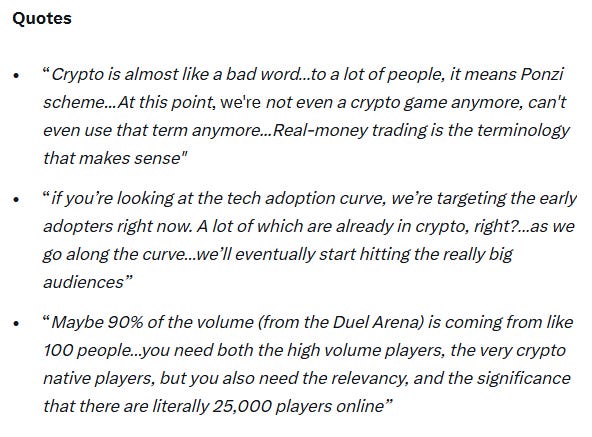
Today, we will be sharing the insights and sprinkling in some takeaways from two founders we spoke with more recently, including:
Payton (Kizuna)
Luke Barwikowski (Pixels and Stacked)

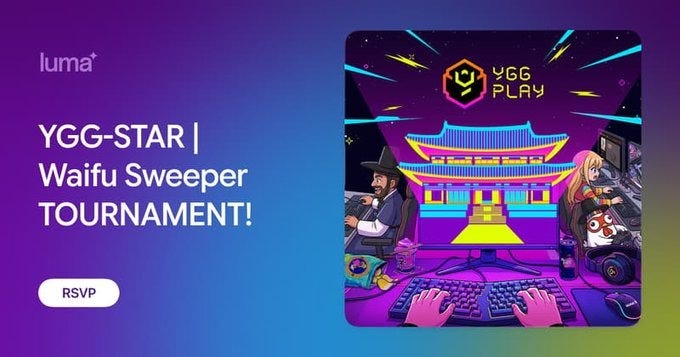
YGG Play is in Korea this week with YGG Star, where you can experience the Casual Degen universe live at JBK Convention Hall, including:
Live Waifu Sweeper Tournament
A GIGACHADBAT Challenge cage
Build games with Verse8
🗓 Saturday, April 18 | 5:30–9:30 PM KST
Sponsored by YGG Play

Payton Kaleiwahea

Payton is the co-founder and CEO of Kizuna, a new Discord-based analytics tool, “that helps community-driven brands convert audience into action, not just reach.” During this conversation, Payton shared his insights from years of community-building:
“Community…is the interaction between people, and that is also your responsibility as a community leader. Not for them to cling to you as the driving force, but also to push into relationships…”
The strength of a community lies in the density of member-to-member connections. Not in the leader-to-member connections. For this reason, you want to create an environment where members form relationships with each other.
“You were part of the Bored Apes, but now you’re not part of it, because you don’t have this NFT. There’s a big issue within the NFT community, that it’s the only way to be part of it…”
“There are a lot of benefits of community that aren’t solely monetary: just drive KPIs down […] There are a lot of things within community that you can have, like marketing, ambassadorships, hiring pools, product-feedback loops…types of things that don’t really have a good connection to money or costs.”
If you treat the community like a KPI, you will miss how it multiplies everything else.
This is where people have a hard time with Discord, because they just think of Discord or Telegram as a chat message platform, when in my opinion, it’s more like Gen Z email.”
Using the Gen Z email framing helps you understand how to approach it: Discord = inbox, Channels = folders, Notifications = emails, Reacting to pings = open rate.
If you look at it (pinging users excessively) from an email perspective, you’re going to get blocked (muted). And your power over a person in terms of broadcasting things to them is now very low.”
Luke Barwikowski

Next, we spoke with Luke about Pixels’ new rewarded play platform, Stacked: “AI-powered rewards infrastructure”. During the conversation, we touched upon P2E, UA, growth, and more.
“Part of the problem (in response to extractors and spenders in Pixels being 98.8% overlapping) is the UA problem. A lot of crypto has not reached an audience of gamers, who are important, in addition to the people playing crypto games right now.”
For your game economy to function, you need to attract an audience that is less EV-sensitive, and essentially “pays for fun.” Unfortunately, the data shows that there’s only a handful of players in crypto that play because of intrinsic motivations.
“If you go and analyze every game in Web3 […] Even in those that are doing $1M in revenue. There are maybe six spenders that that $1M of revenue […] It’s a shockingly small number of users that drive the spend in these games.”
We have known for a while that the space has been held up by a small userbase of high LTV players. But if it is as bad as Luke says, that’s concerning. Especially considering the space continues to shrink.
“I’m strongly feeling that if we give people the option to cash out via PayPal or crypto. And PayPal, if it takes 1-3 days, and crypto is instant, I have a feeling that a lot of normal people will still choose crypto.”
“As a founder, it’s really easy to think that other people are wrong: ‘These people are wrong, there’s this thing that they should like’. That’s just not how the world works. You do have to build around consumer expectations. If you offer them something that surprises them, that’s genuinely better, that’s great, but if you try to force it down their throats, they’re just going to avoid the product in the beginning stages”
If there’s a feeling that the user has to be educated a lot to understand the value proposition of the product. You’re likely building against consumer expectations instead of around them.
“Are they going to move the needle for the user experience and for Stacked as a company? The reality is: I’m not so optimistic about Web3 games right now. So, what do we really need for Stacked to work? One, we need our first-party titles to work well, or we need Web2 games that have the economics to fit this into”
This was a response to how Luke is thinking about growth for Stacked, as the infrastructure can only be as good as the games being built on it. If Stacked can attract Web2 games and execute, this might spark an interesting wave of crypto gaming adoption through rewarded play.
“You can almost consider this thing they did (Cash App’s Cash Apples) as a playable ad […] These apps, do you know how much they pay per user? Their CAC is often $20 - $100, so if they give out $5 in rewards, and somebody new joins Cash App, because of it. That saves them so much money”
Closing
And that’s another week of gaining valuable insights from builders in crypto (gaming). We thank Payton and Luke for coming on the show, and look forward to having Jihoz (Ronin) and Kohei (Pandemic Labs) on later this week.
For more builder insights on topics ranging from growth to tokens to liveops, and much more, I recommend checking out “24 Lessons from People Actually Building Crypto Consumer Apps”.
Disclaimer: None of this information should be taken as financial advice. My writings only represent my personal opinions. DYOR. I will hold some of the assets mentioned in this newsletter.