

Crypto gaming might be experiencing a “renaissance.” Recently, we’ve seen lifeblood return to the category, fueled by the success of the game Kintara. What particularly interested me about Kintara isn’t the game, but its token: $KINS, showing a remarkable performance and sustainability (thus far). Especially considering the underperformance of the crypto gaming category.
In the past years, I’ve witnessed and logged 100s of gaming token launches. Many of these launched through a CEX or DEX, a few on a launchpad, and even fewer on @Pumpfun (PF), until recently. This made me arrive at the question:
Does Pump Fun provide a better token launch model for gaming tokens than the CEX route?
Pump Fun’s Shift to Builders
PF is/was largely known as a memecoin launchpad, and not so much for project/utility-backed tokens (or “builder tokens” as I will refer to them). However, more recently, it has been pushing the platform in a direction to align itself with more builder-minded deployers. In 2026, it launched initiatives such as the Pump Fund, the BIP hackathon, and positive changes to the creator fee model.
The most successful project coming out of this push is @pumpcade. Its story set a standard and created a narrative for other builder tokens to erupt. And the trend of gaming tokens we recently saw (sparked by Kintara’s success) is the next iteration of these types of tokens.
So, why launch on PF? Kosgood, the former COO of PF and now at Pumpcade, explains it well in the clip below:

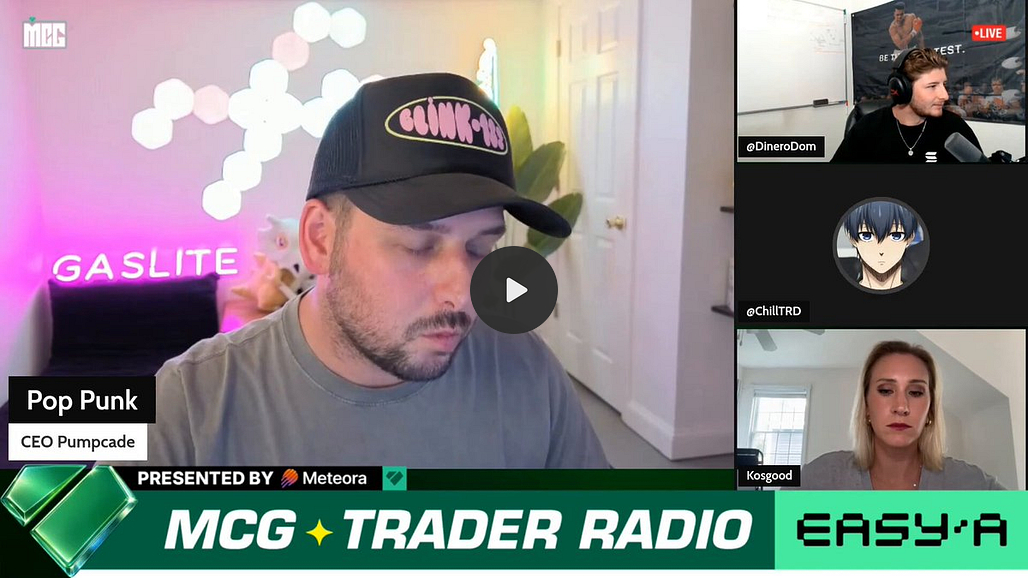
“Launching a token, especially on pump, could be the best thing that you do for your company. It helps validate your idea. If people seem interested, you start gaining community and you get early feedback.
If you don’t have funds, it’s amazing for getting those initial funds, but it also helps sculpt the vision of your company.
Approach it as a speculative tool and a marketing tool, and maybe integrate it into your product one day. It can end up snowballing into the most valuable asset you have for your entire company.”
In summary, it’s a tool for validation, community, bootstrapping, marketing, speculation, and building momentum. But most interestingly, it changes how (gaming) startups can get funded and monetize.
“The Typical” Game Token Launch
“The typical” (gaming utility token on a CEX) launch model, as we know it, is broken, and the proof is in the charts. In this section, I will go over what’s broken specifically and how a PF token could potentially solve/soften these inherent issues.
A Lack of Organic Price Discovery
Gaming utility tokens are often used as a vehicle to raise funds. Naturally, this pushes the listing price of these tokens up. In many cases, to a level at which the token launches at too high a valuation for any buyers to be interested. This makes the open and upward price discovery limited.
In contrast, a PF launch is much more egalitarian. Anyone can participate. It starts at a low valuation (~$2-$5K) on the PF bonding curve. This curve only gets completed (and “launched” to a DEX) when 793M out of the 1B tokens have been bought, which happens approximately at a $70K market cap.
So, the potential upside for a PF token is in the 100Xs, if not 1000Xs. Compared to a typical launch, the upside is capped much more significantly.
Speaking of upside, rewarding your early believers (making them rich) remains the strongest token enforcer in crypto, because of a couple of reasons:
An early buyer making the right bet triggers psychological effects: validation and ego reinforcement, identity fusion (e.g., “the guy that was early with Kintara”), and reciprocity.
It turns holders into evangelists. The incentives are aligned because the holders’ wealth is correlated to the success of the token. This makes them inclined to go out there and contribute to the further growth of the token.
Being an early winner creates status. In crypto, that has value because it can be leveraged for monetary gain, networking purposes, and access to greater opportunities.
Less Predatory Monetization Mechanics
The main ways teams make money from their token also often happen to be “predatory” (contradictory) to the token’s success. Think of fundraising rounds, OTC deals, selling team-based unlocks, and selling tokens from game revenue.
Launching a token on PF comes with “creator fees.” A dynamic fee model that gives the developers a cut of the trading fees. So, the more volume being generated, the more revenue (fees) the deployer makes. As the team benefits from ongoing market activity, this creates a strong incentive for them to return attention and value to the token, at the same time making it less attractive to sell off their own supply.
On the topic of value accrual, it’s also worth talking about buybacks. We’ve seen dozens of teams incorporate a buyback strategy over the past 1.5 years. However, in most cases the benefits remain opaque. On the other hand, in terms of a PF-token, the upside seems clearer. Here, token velocity is directly linked to revenue through creator fees. When this revenue is used for buybacks, this creates a clearer flywheel:
Buybacks → trading volume up + supply goes down → holder confidence goes up → sustained/increased token velocity → more trading fees → more buybacks
A good example of a team benefiting from this model is Clash of Perps. The founder, Xaitoshi, told me during an interview that they make around $400 per day. So, ~$12K per month. As a primary revenue driver, it allows them to sustain their 2-man operation.

PF fees allow teams to monetize the speculative behavior of the market. At the same time, teams can still monetize the in-game experience (like Clash of Perps) through IAPs, IAAs, subscription models, NFTs, entry fees, etc. It creates a clear distinction between how the two can be monetized separately.
Different Unlock Model
Most of the tokens in this category launch with a 10 - 20% float, meaning another 80 - 90% of the tokens will be introduced to the market post-TGE. Typically, over 3-4 years. Additionally, teams own 40 - 50% of the supply. For almost all tokens, this prolonged increase in token supply leads to continuous sell pressure and uncertainty post-unlocks. Simply because teams can’t absorb the supply increase at a high enough rate.
PF tokens (that graduate) roughly have an 80/20 community-team split. So technically, every token has an 80% circulating supply the day it launches, and new supply is introduced (the 20%) if the deployer decides to sell its token allocation. But the team can freely trade this supply, as it isn’t locked up by a vesting schedule, which introduces risks I will get into later.
So, PF’s model isn’t perfect either. Performance-based unlocks could be a solution here, as it would decrease the risk from the buyer side significantly, while at the same time creating more alignment between the team and the token’s performance.
However, the result is a token that trades much closer to its “real” market value, that isn’t plagued by continuous supply unlocks. Especially because of the “FDV shenanigans” (low float, high FDV) we’ve seen in the past few years, which have contributed to the majority of tokens peaking at TGE, and then going down forever after.
Tap into Different Audiences
The typical gaming token launch attracts sellers, farmers, and extractors. But it often cannot tap into the audiences that are interested in buying the token.
To illustrate this point, it’d be helpful to describe the gaming and PF audiences, and show how they’re different:
The gaming token audience: Often a mix of grinders, farmers, and a handful of enthusiasts. Many come from regions where playing can supplement income (P2E).
Pump Fun audience: Crypto-native speculators. They treat tokens as pure financial instruments or lottery tickets. These people are the degens or gamblers.
Both audiences have the same goal: to make money. However, the means of getting there are different. The gaming audience is willing to invest significant time to earn tokens. The PF audience is less willing to invest its time, but more willing to gamble its money for asymmetric upside.
In the context of how both interact with a token launch, the gaming audience optimizes for yield extraction (sell airdrop and grind for tokens), leading to selling pressure. On the other hand, the PF audience optimizes for speculation, with the result of buying pressure (initially at least) to chase the asymmetric upside.
The upside of gaming tokens is usually capped by adoption, valuation mechanics, inflationary emissions, etc. On the other hand, the potential upside of PF tokens is much higher, as said. For this reason, most gaming tokens aren’t interesting to the degen audience as they don’t offer the asymmetric upside they are looking for.
In the context of Kintara
Kintara has found a crossover: attracting the gaming audience (motivated by P2E), while the PF audience provides the capital and liquidity to sustain the token price. At the same time, some of the speculator crowd turned into players as well to double-dip on the opportunity (e.g., PinguCharts).


In this post, Raiden explains well why the game managed to attract the degen audience: the PF-crowd primarily buys into a narrative they can tell themselves, and others (”a memecoin wrapped under a gamified exp.” + “the next Axie”). The buying decision here is driven by a thesis, not so much by the game itself.
At the same time, the gaming audience creates utility and demand for the token through (incentivized) play. And even though the game’s metrics (e.g., player numbers) are mostly vanity, they still “validate” the thesis. This creates a strong flywheel:
Thesis → validation → token goes up → enforces thesis.
Bag bias plays a big role here too. Because holders are financially invested, they have a strong incentive to say the game is fun/good, even though it isn’t objectively good or innovative. This makes the narrative self-reinforcing and keeps speculative capital around longer than a pure memecoin play, because there’s activity backing the story. However, it also means if the narrative were to collapse, the token would likely too.
What Teams Benefit the Most from a Pump Fun Launch?
Launching a token on Pump Fun makes more sense for a tiny startup (1-5 employees) than any larger company, as you might have guessed. As said, it's a tool for validation, bootstrapping, and building momentum. The smallest teams benefit the most from that, while it might be too much of a risk for larger, VC-backed companies, aiming for a higher valuation.
In a way, you could argue that Pump Fun flips the typical token launch model on its head. Instead of build → traction → token (the CEX route), PF goes token → validation → build. More in line with a Kickstarter campaign.
Looking at the breakdown of creator fees below, you can see that the funds aren’t significant enough to sustain larger operations without supplemental revenue streams. A token in the mid-tier (~$2.5M market cap), doing a $100k volume per day on average, would “only” generate $15K in monthly fees if they were to stay in the same fee bracket.
However, that doesn’t mean that teams can’t use their (initial) success on PF as a springboard to greater heights. Pumpcade started as a 1-man operation, led by Pop Punk. The PF fees allowed him to fund development, and continued success was leveraged in two funding rounds, naturally followed by expansion.
Is it Applicable to Gaming?
“But gaming is capital intensive, and requires capital up front”
It’s a valid argument, as venture capital made the category of crypto gaming possible in the first place. However, the outcomes of the majority of funding in A, AA, and “AAA” crypto games have almost been nothing but underwhelming. As a result, the industry’s venture investments have shrunk massively over the past few years.

That’s why I believe the future of this category will be much more indie. Mostly solo devs or very tiny operations will try to come up with a “minimum monetizable game loop” (essentially “validation”, as Kosgood spoke of). Based on the marketability of this loop, it either gets scrapped or the teams continue to build and add features, content, and systems to turn it into a fully fleshed-out experience over time.

Current AI tools haven’t solved game development, but they do exponentially increase what a small team can accomplish in a short time.
The Risks/Downsides
For now, I’ve only addressed the benefits of launching a (gaming) token on PF. However, it would be unfair not to address the downsides as well. Because the risk is two-sided, the following arguments will be from both a deployer’s (launch) and buyers’ perspective.
Bad Actors
The biggest risk with tokens on PF, from the buyers’ perspective, is that the chance of getting rugged is much higher than with a CEX launch. The barrier to ship a game has been lower than it ever has, and the rewards (potential upside) are there, making the incentive to exploit this opportunity larger than ever before.


We’ve seen this with how Kintara’s success spawned a wave of new (sloppy) projects. Half-assed games, if you can call them “games” in the first place. Or even worse, projects pretending they’re building a game while stealing or faking game footage.
Buyers will have to navigate this space carefully and train their due diligence skills if they don’t want to be caught buying the wrong tokens. Especially considering there’s no “policing” (curation) on PF at all. This will always remain a sub-optimal experience. For the untrained eye, this means that the chance of a rug is quite significant. And a first experience that ends up in a rug seems like a high churn point.
I believe a better solution to this would be an improved incentive model (for builder tokens at least) that encourages long-term holding + project development, instead of straight up rugging.
In the example of FRAG, the incentive for the developer to rug was greater than to continue to build. Let's say he was able to secure $100K at once, instead of having to continue to ship for 10 months to get there through creator fees and in-game revenue with the risk of the token going to 0 in the meantime.
"Show me the incentive and I will show you the outcome" ~ Charlie Munger
Lack of (Good) Devs
Even though everyone can now be a developer (i.e., vibecoder), crypto seriously lacks serious, experienced ones that can build apps that matter. Just look at all the new L2s out there. Ultimately, almost all of them could use new, meaningful apps. However, despite the relatively strong incentives to build in crypto (with fees, grants, tokens, etc.), there aren’t enough good developers.
The most obvious reason why seems to be the negative connotation the outside world still has with the word “crypto.” The risk and reputation damage simply doesn’t seem worth the reward. And particularly, PF isn’t trying/design to improve this reputation, as memecoin launchpads are likely the largest vehicle for scamcoins to be created in the first place.
Furthermore, there’s a huge risk for a developer to be constantly attacked by malicious actors trying to extract, as recently seen with the example of Voicebox. Luckily, in this case it ended well, but in many cases it doesn’t.


To emphasize this point, there are hundreds, if not thousands, of indie game devs out there who are all desperate for funding and players. Crypto can provide both to them (even though the latter is debatable), yet most of them will never come near it, as they despise this industry.
I’m not sure if it can be solved, but I hope PF will continue to push initiatives for builders and attract more serious developers.
“Caballing”
Every project has a group of insiders that benefit the most from a token launch, whether that be VCs, angels, the team, or a group of KOLs. With a typical CEX launch, it’s usually fairly transparent which groups hold tokens, how many, and when they’re able to sell, as you can simply look at the tokenomics. However, with PF launches, it isn’t, and with the more successful launches, there often is some “caballing” at play.
A token that seems rather suspicious of some cabal play is none other than Kintara’s KINS. When the token took off, it felt like a coordinated effort from multiple memecoin accounts to push this token. There also wasn’t a strong reason for these accounts to push KINS at the time (or it was hidden from the public). But again, these are mere suspicions. However, you could argue against how organic the price discovery of KINS really was.
In the case of KINS, the fact that the cabal was likely involved wasn’t the worst, because it hasn’t been a huge extraction event. Yet, often, the behavior leads to only a small group of players benefiting, while the rest incurs losses.
Concluding
To get back to the question of this article:
Does Pump Fun provide a better token launch model for gaming tokens than the CEX route?
My answer would be yes. Specifically, from a token perspective, the PF model allows for:
Better organic price discovery
Less predatory token-based monetization
A better token unlock model
Reaching different audiences, with more spending power
Overall, leading to better alignment between the success of a product and the token.
Additionally, a PF token can be a powerful tool for validation, community, bootstrapping, marketing, speculation, and building momentum, with benefits that a typical CEX launch can’t parallel.
But of course, there’s nuance. Tiny tiny operations are much more likely to reap the benefits of a PF token than companies that are more than ~5 employees, I’d say. A PF launch is more of a springboard toward greater heights than a solution for an already VC-backed company.
Furthermore, PF is still plagued with the problems of bad actors (scams), a lack of good devs, and practices such as cabbaling. Without PF continuing to make the platform a more developer-friendly environment, I’m afraid it will fail to see a growing interest from this community to launch on the platform.
What’s your take on the wave of gaming token launches on Pump Fun?